A colleague’s good practice. Recorded in three taps.
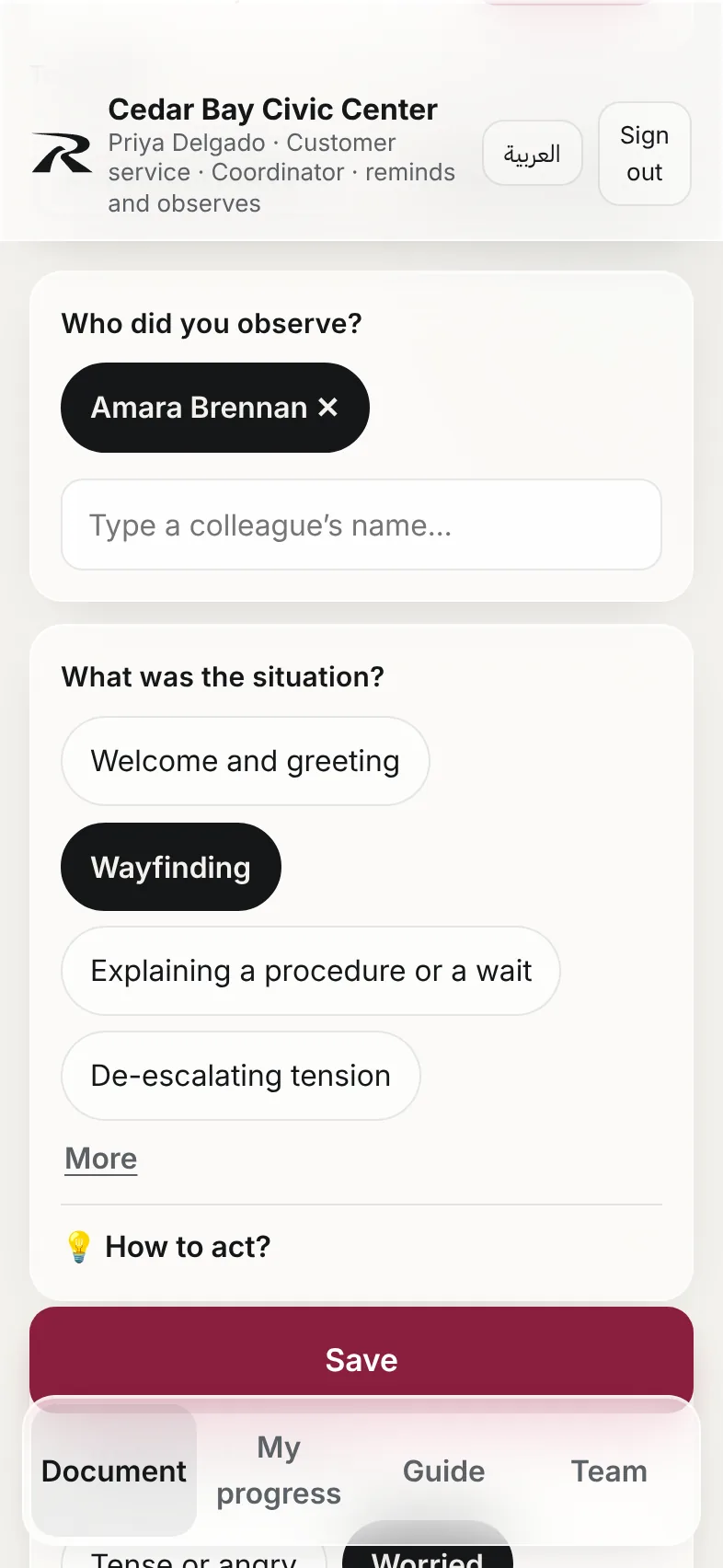
The app for frontline teams in any institution. Coordinators document good practice in seconds. Every colleague keeps the department’s guide alive in two minutes a day. Management sees the change against its own targets.
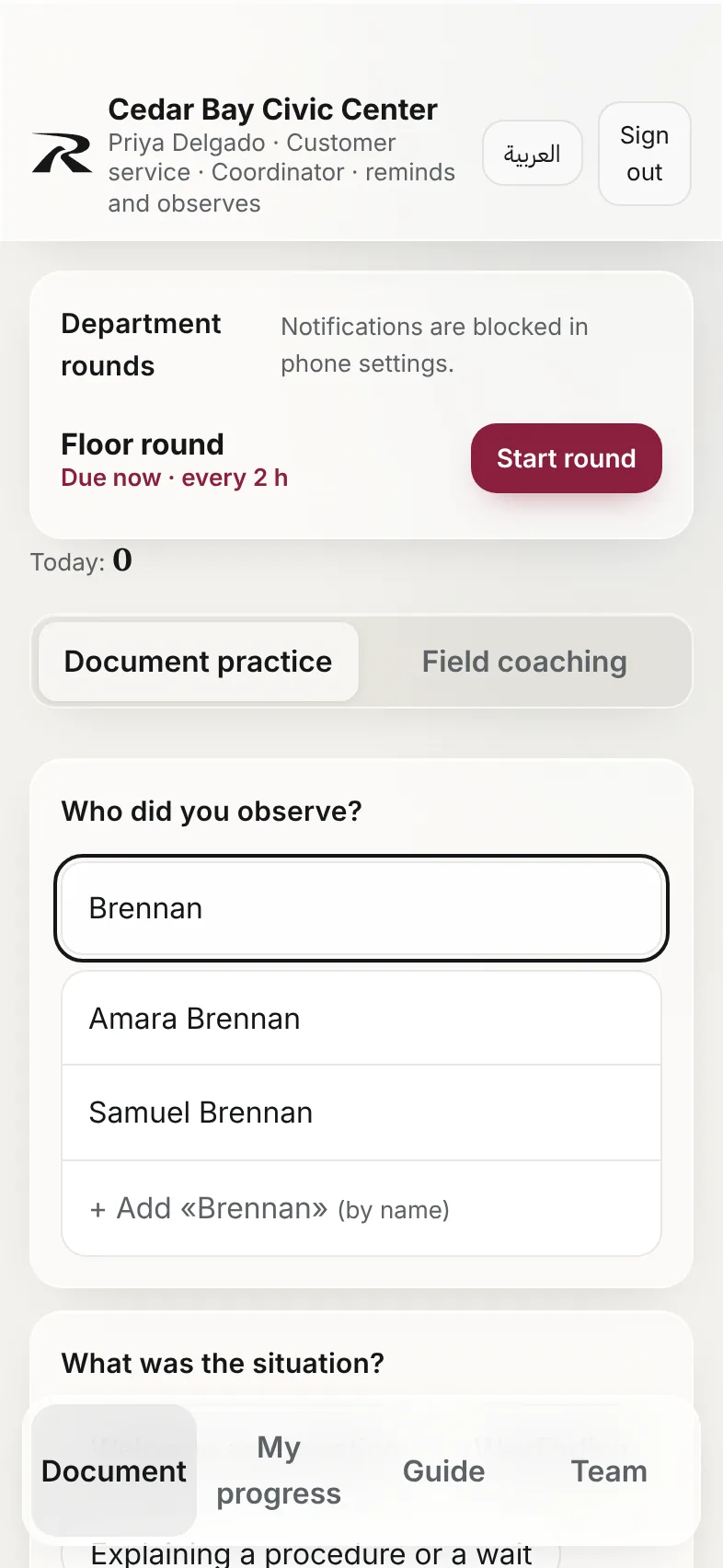
Everything a round needs. In the hand that walks it.
Is their next step clear to them?
A visitor reaches the desk while you finish a call.
Finish the call, then look up. Look up and signal you will be with them in seconds. Tell them to sit and wait.Acknowledging them at once, even with a gesture, makes them feel seen.
The same practice, from where each of them stands.
Her phone tells her the waiting-room round is due. She walks it. Then she records what a colleague did, before the moment passes.

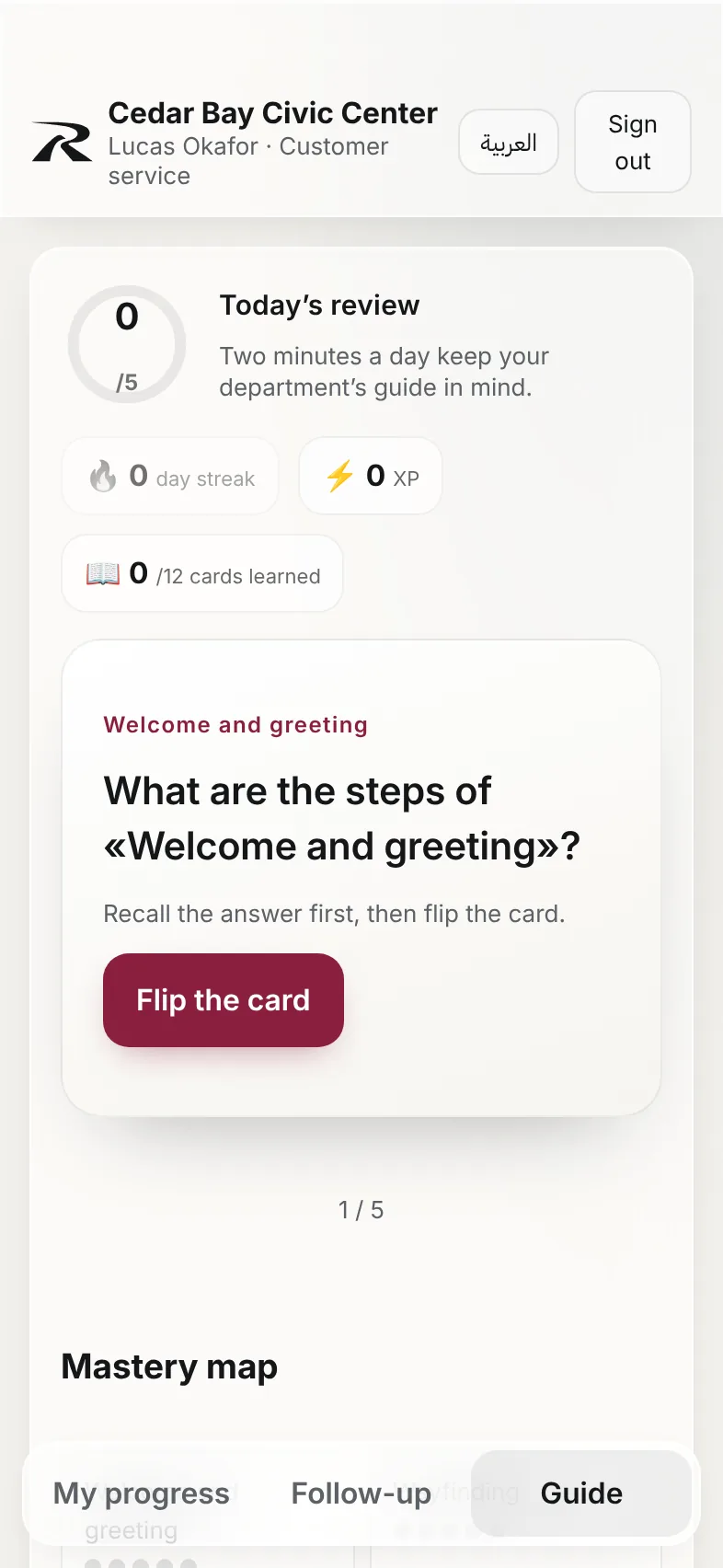
A quiet moment at the desk. Five cards from her own department’s guide: the steps, why they matter, what a coordinator would see.

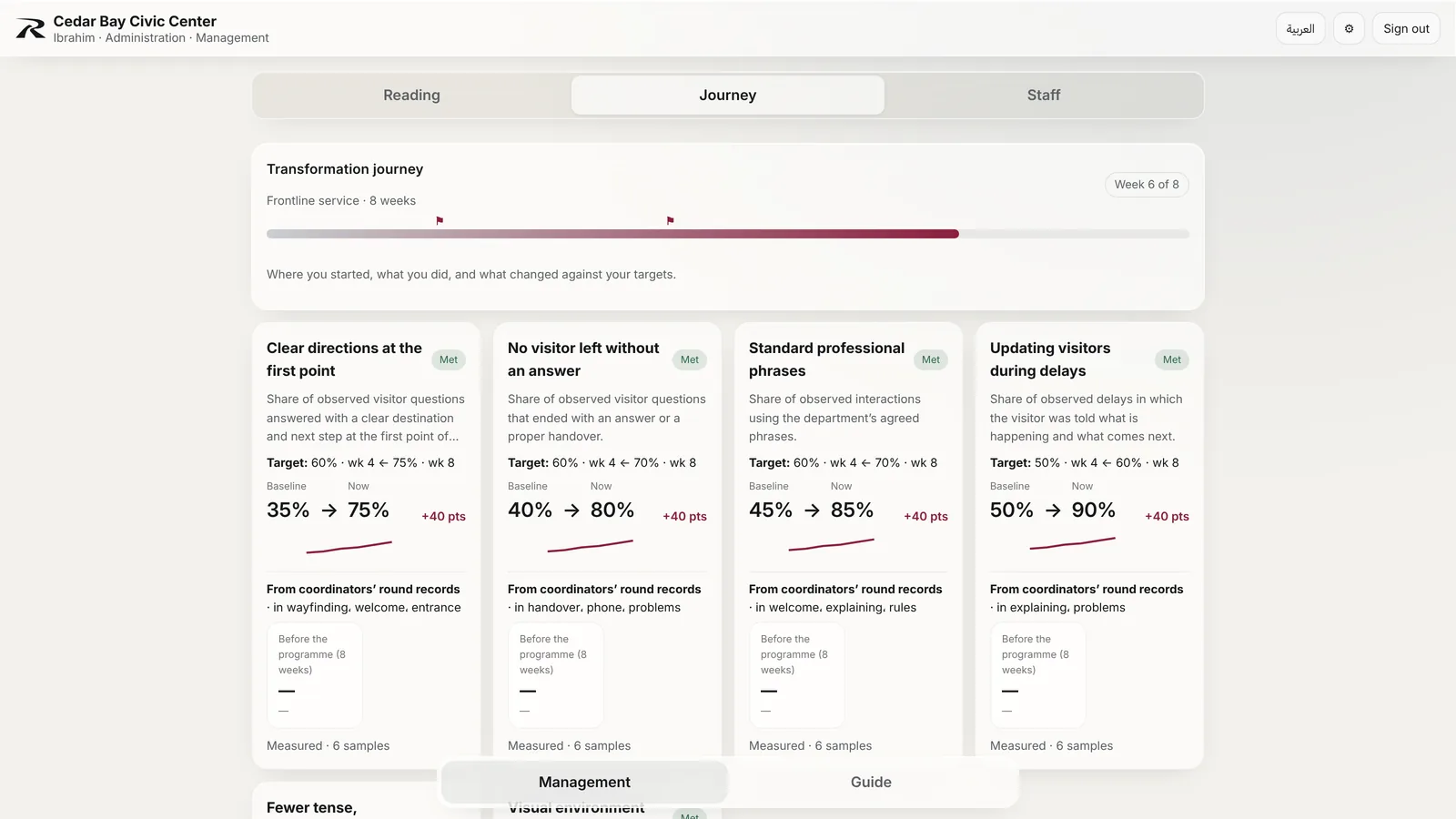
At the end of the week, management opens the transformation journey. Each indicator sits against the targets the institution set for itself. Every intervention sits on the timeline.


Frontline teams work under pressure. Long forms get skipped. So Reflection asks for a few taps, at the moment it happens.
Each department starts from its own guide. No guide yet? Start from a ready profile for front-line service and adjust it.
The phone reminds coordinators when a round is due. A few taps per check.
What a colleague did, in which situation, on their own or after a reminder.
Each person follows their path. Management follows the journey against its targets.
Install from the browser on iPhone or Android Saved on the phone first, sent when the network returns Staff join with their department’s QR card, approved before they get in

Good service is a person, at the right moment.
Reflection helps teams see that moment, repeat it and teach it. The people decide.Reflection does not grade people. It keeps the evidence of what they did, in the situations their own department defined. Then people decide what it means.
An emergency department is not an information desk. A bank branch is not a school office. Each department works from a short list of real situations, each with three steps, the reason behind them and what doing it right looks like.
Name, role and what happens next reduce anxiety from the first moment.
Your past round notes already mention colleagues by name. Reflection proposes each one with the exact sentence it came from. A person approves, corrects or dismisses it. Until then, it counts for nothing.
Waiting area, evening shift. Maya Saad was calm and explained the wait to a worried family.
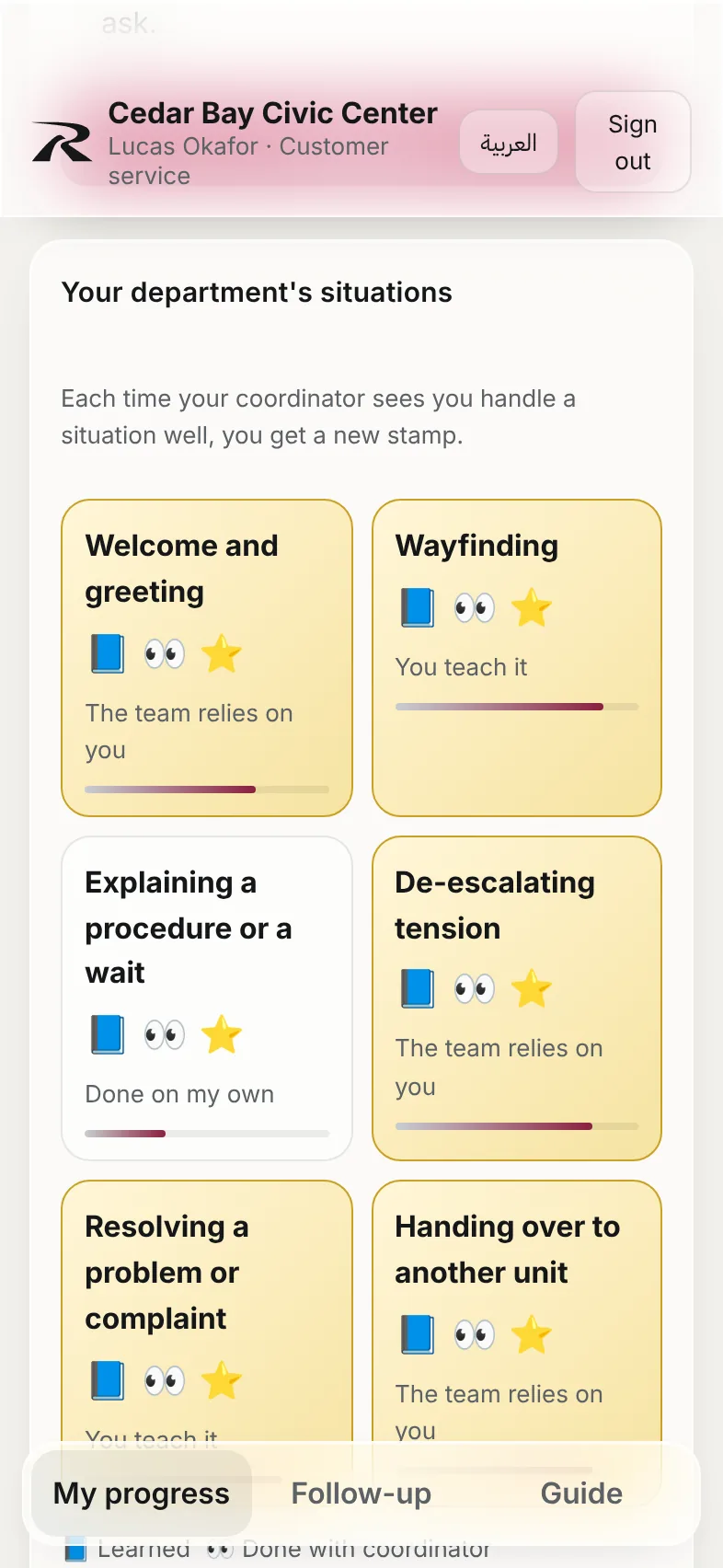
A level rises only from observations recorded under a person’s name, and confirmed again after a week, two, four and eight. Ten observations on one busy day count as one. A miss does not erase what was seen before. And time without an observation never removes a level. It asks for a fresh look.
Upload a department’s guide as PDF, Word or PowerPoint. Reflection proposes its situations, steps, observable behaviours and short scenarios. Nothing goes live until a person reviews and approves it. Then every colleague reviews it two minutes a day.

Every department has its routines: an hourly waiting-room round, a lobby round every two hours. The coordinator’s phone says when one is due. Each check is a tap. Obstacles are named on the spot.
Anyone feeling left alone?
Obstacles
Upload what you already have: a baseline study, an assessment deck, a report. Reflection proposes each department’s starting point, each point with the exact quote from your document. A point whose quote is not in the document is dropped. A person keeps, edits or removes the rest.

Departments and practices only. Never individual people.
The coordinator is the living model of the guide. When people move on, the role moves easily too.
About a third of a frontline team. They walk the rounds. They coach on the job. They document, by name, what colleagues did.
No forms to fill. They see what was documented with them, review their guide daily and follow their own path.
Follows the journey and every department. Approves who joins through each department’s QR card. Decisions about people stay with people.

Each design choice comes from published research. Here is what it found, and what we built with it.

Students who were tested on material remembered more after two days and a week than students who restudied it.
In Reflection: the daily review asks before it shows the answer.
Roediger & Karpicke, Psychological Science, 2006A quantitative review of the research: spreading practice out beats massing it, and the best gap grows with how long you need to remember.
In Reflection: cards return at growing gaps, and levels are confirmed again after 7, 14, 28 and 56 days.
Cepeda et al., Psychological Bulletin, 2006People repeating a new daily behaviour took 66 days on average to reach peak automaticity, with wide variation between them.
In Reflection: “steady” needs correct practice seen again over weeks. One good day is not a habit.
Lally et al., European Journal of Social Psychology, 2010Entrustment moves through levels, from observing, to acting under supervision, to supervising others.
In Reflection: levels go from learning to go-to colleague, and the top level makes someone eligible to coordinate.
ten Cate et al., Journal of Graduate Medical Education, 2016A run chart plots a measure in time order, so a team can judge whether a change led to improvement, not just a lucky week.
In Reflection: every indicator is a run chart, with interventions marked as sequence, not cause.
Perla, Provost & Murray, BMJ Quality & Safety, 2011In a 14-day study, longer questionnaires raised the felt burden and lowered both the amount and the quality of the data.
In Reflection: a few taps per observation and per round check.
Eisele et al., Assessment, 2022Game elements help learning modestly, and the effect is most stable for knowledge (Sailer & Homner, Educational Psychology Review, 2020). So Reflection keeps streaks and a mastery map for each person, and leaves out leaderboards. Source
Software keeps the evidence. Levels, names and starting points count only after a person approves them. Promotion stays with the institution.
Each person sees their own path. Team figures stay hidden below five people.
No location, keystroke or screen tracking. Only what a coordinator documented. And the person can see it.
Reflection records the situation, never who the visitor, patient or customer was.
No data reads as not measured, never as zero. No observation reads as not observed yet, never as weakness.
Every point read from your documents carries its exact quote. Without the quote, the point is dropped.
Try it for 14 days. Every feature, from the first day.
$8/ user / month
For a department whose practice has to hold. Documentation by name. Rounds on time. A living guide, and a two-minute daily review for everyone. From $1,500 a year.
Start a 14-day trial$14/ user / month
For the whole institution. Every department with its own guide and rounds. Recurring issues surfaced early. A library of model practice. From $3,000 a year.
Start a 14-day trialLarger teams subscribe online too. Reflection Pro covers every department. Pay yearly and get two months free.
Start a 14-day trialPrices in USD, before tax. An active user is anyone who signs in during the month. Pay yearly and get two months free. The 14-day trial needs a payment card. Nothing is charged until it ends. Secure checkout by Paddle. Annual agreements and invoicing for institutions. Every payment, fully refundable for 14 days. Refund policy · Terms
For any team that serves people face to face: hospitals, schools, universities, banks, municipalities, NGOs and service desks. Each department works from its own situations and guide, so the app fits the work, not the other way round.
No. Start from a ready profile, such as front-line service, information desk, admission, security or emergency, drafted from public evidence. When you upload your own guide, it replaces the draft once a person approves it.
No. Levels move only on observations a coordinator recorded under a person’s name. A name read from a note or a file counts only after a person approves it. Decisions about roles and promotion stay with your institution.
Their own path, what was documented with them, their guide and their daily review. Nobody sees a ranking of colleagues.
Yes. Import coordinators’ records from a spreadsheet or a form export. You preview first, then confirm. Uploading the same file twice skips rows already imported. Names in the notes are proposed with their sentence and count only once approved.
Every entry is saved on the phone first and sent when the network returns. Install Reflection from the browser on iPhone or Android.
Each department gets its own printed QR card. Nobody gets in until someone responsible approves.
Yes. Try it for 14 days first. After that, every payment is fully refundable within 14 days.

Start with one department. Fourteen days, every feature. Card required.