ROADYOM
EN
Get started
For municipalities

A town hall is judged at its window.

A permit, a certificate, a broken street light. Residents meet their municipality through a handful of employees. Those employees are its image.

Service halls and markets No political inference Decisions kept with their reasons

A municipal building in the morning, seen from the square
Where the image is made

Public service is a person, not a building.

Residents rarely read a council decision. They live it through the clerk who explains it. When that person knows the reason and says it clearly, the decision feels fair. That is where trust in local government is made.

  1. The permit window

    The second visit.

    Which documents, which stamp, how many days. One unclear answer means the resident comes back, and tells the neighbours why.

  2. The complaint at the counter

    Does anyone own it?

    A flooded road, a pile of waste, a noisy site. The resident wants one thing: to know that someone owns it, and what happens next.

  3. Market and festival days

    The whole town is watching.

    Vendors apply, booths are assigned, fees are paid, crowds arrive. Every unfair-looking choice becomes a conversation.

  4. A new council

    What was decided, and why.

    Councils change and heads of department retire. Without a record of reasons, every old decision has to be argued again.

A coastal town seen from above in the morning haze

A town remembers how it was served.

One window at a time.
What the research says

Evidence first. Then the product.

We read the research before we build. Here is what it says about this work, and what it means in practice.

We cite research to explain our method. It is not a promise of results in your institution.

Where each product fits

The belief, made practical.

For the service hall, the town’s memory and its public days.

ROADYOM REFLECTION Inside

The service hall, one round at a time.

The Front-line service guide covers what residents meet: welcome, wayfinding, explaining a procedure or a wait, resolving a complaint, handing over to another department.

  • A floor round every two hours, three questions each.
  • Arabic and English today, more languages coming. Works offline.
Explore Reflection
A municipal building seen from its square

ROADYOM STAR Events

Markets and fairs, from application to evaluation.

One link for every vendor application. One list to decide from, with each vendor’s past events and ratings beside it. Booths on a floor map, fees, and event-day check-in.

  • The organizer decides every application. Nothing is accepted automatically.
  • Nothing is deleted when a plan ends.
Explore Star
Star on a desktop: the floor map of a three-day market, booths taken and free

ROADYOM PRISM Memory

Decisions that outlive a council.

Each decision with its reasons, each procedure with its date, each lesson with its source. When the council changes, the reasons stay. When a plan ends, the memory stays, read-only.

  • A steward ratifies what becomes trusted.
Explore Prism

Every item in Prism carries one of four levels.

  1. 1 Ratified A steward confirmed it. Search ranks it first.
  2. 2 Evidenced It points to a source you can open.
  3. 3 Observed Someone saw it in the field.
  4. 4 AI-inferred An assistant wrote it. It stays here until a person ratifies it.

ROADYOM MIRROR Outside

The town’s view, in public.

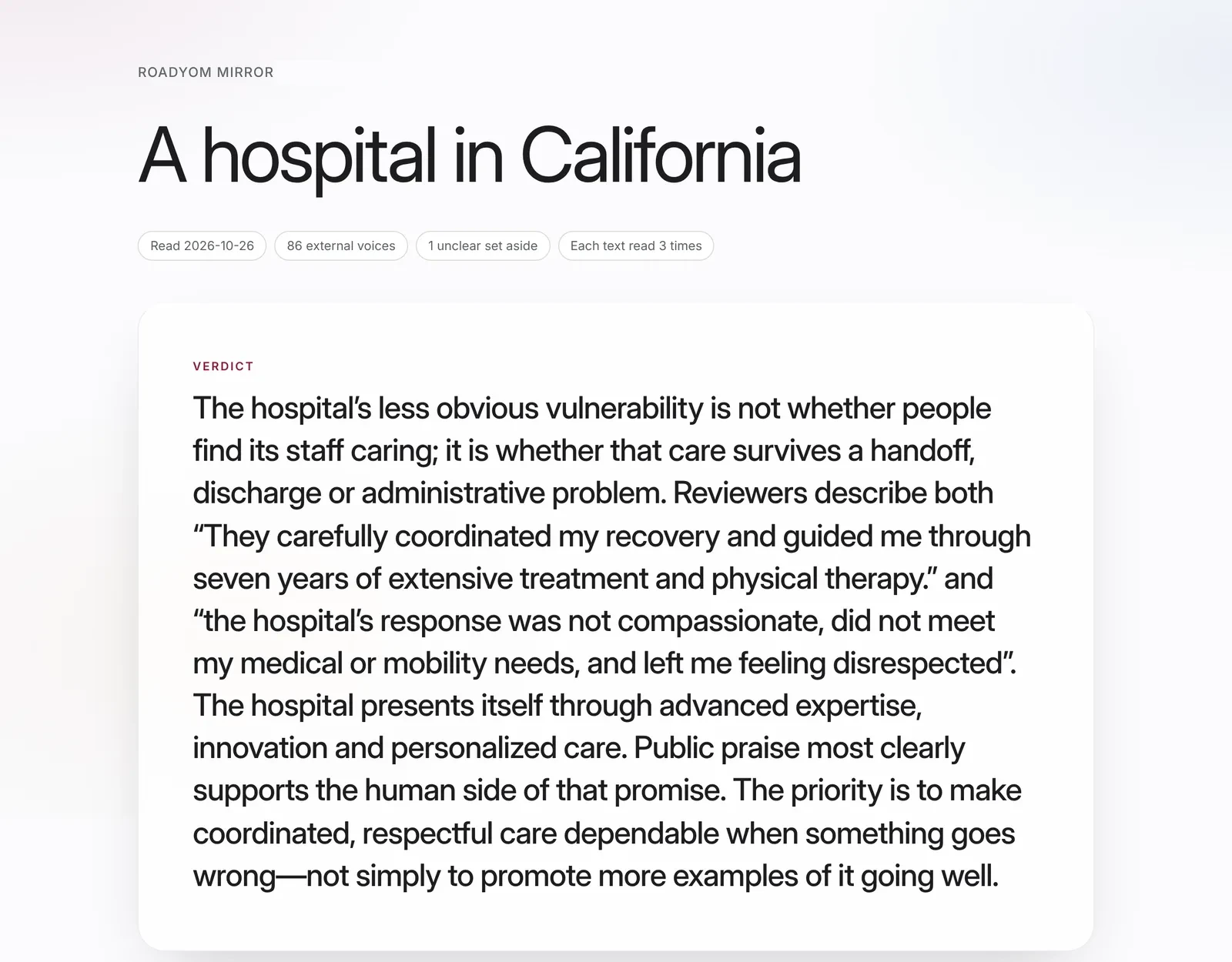
Mirror reads public reviews, videos and news coverage about the municipality, and sets them beside what it promises. It never infers religion, sect or political views.

  • When public evidence is thin, the reading says so.
Explore Mirror
The verdict of a real Mirror reading, with its sources

From a real Mirror reading of a hospital in California, built from public sources. Names withheld.

Your first 30 days

Start small. Start this week.

One service hall. One month. If a market is coming, Star joins in week three.

  1. Week 1

    Choose one hall.

    Permits or citizen services. Name a coordinator. Mirror reads the municipality’s public coverage.

  2. Week 2

    Write it with the window.

    The questions residents ask most, answered the same way by everyone. Staff join by QR. A manager approves.

  3. Week 3

    Round at opening time.

    Coordinators record good practice by name. If a market is near, open vendor applications in Star.

  4. Week 4

    Record the reasons.

    Put the month’s decisions into Prism with their reasons. A steward ratifies them.

Honest scope

What Roadyom won’t do.

Knowing the limits is part of trusting the tool.

Not an e-government portal.

Residents don’t file requests or complaints through Roadyom.

No resident data.

Reflection records the situation, never the person served. No tracking of residents.

No political reading.

No product infers religion, sect or political views, from text or from anything.

No processing-time metrics.

It doesn’t time files. It shows how practice moved against your targets.

How we handle data, product by product

Questions, answered.

Can residents send complaints through Roadyom?

No. Roadyom works with your staff. Your existing channels stay as they are.

We are a small municipality.

Start with the people at one counter. Team figures appear once a group has five or more.

Is it politically neutral?

Yes. No Roadyom product infers religion, sect or political views. Mirror reads institutions, not individuals.

Is Star only for large fairs?

No. It suits weekly markets, seasonal fairs and festivals, from application to evaluation. It starts at $149 a month, with a 14-day trial.

What happens to our memory after the term ends?

The memory belongs to the municipality, not the council. If a Prism plan ends, it stays, read-only.

Start at one window.

A live 30-minute demo, built around your service hall.