ROADYOM
EN
Get started
For banks and service branches

Trust is counted at the counter.

Customers rarely meet the strategy. They meet a queue number, a teller, and a person who either explains or doesn’t. A branch’s image is made by its people.

Built for front-line service No account numbers, ever People decide

A service hall in the morning: counters behind glass, chairs waiting
Where the image is made

The branch is the brand, in person.

Campaigns promise ease. The branch delivers it, or doesn’t, one customer at a time. The people behind the glass carry the bank’s name all day. They deserve to know what works.

  1. The ticket and the screen

    A number that doesn’t move.

    A paper ticket, a screen stuck on the same number, no word from anyone. Uncertain waits feel longer than known ones.

  2. “Not at this branch”

    Sent elsewhere, empty-handed.

    A request this branch can’t handle. Sent away without a name, a number or a next step, the customer leaves with a story to tell.

  3. The unexplained fee

    A rule, or a trick?

    A charge on the statement. The explanation at the counter decides whether it reads as a fair rule or as a surprise.

  4. The door

    The guard is the first greeting.

    Before any teller, a security guard meets the customer. A helpful question, or an interrogation, sets the tone for the visit.

Two colleagues review a printed page together at a front desk

How staff experience the branch, customers feel.

It was measured in bank branches forty years ago. It still holds.
What the research says

Evidence first. Then the product.

We read the research before we build. Here is what it says about this work, and what it means in practice.

Journal of Applied Psychology 28

Branches where staff and customers see the same thing.

A study of 28 bank branches, 142 employees and 968 customers found that employees’ and customers’ views of service went together. Both were linked to customers’ intentions to leave the bank.

A branch’s service climate is built by its people. Reflection gives them a way to see and repeat what works.

Schneider B., Bowen D.E., “Employee and customer perceptions of service in banks: Replication and extension”, Journal of Applied Psychology 70(3), 1985
The psychology of waiting 8 rules

Occupied time feels shorter.

Maister’s propositions: occupied time feels shorter than unoccupied time, and unexplained or unfair waits feel longer. Much of a wait is how it is managed, not how long it lasts.

Reflection’s floor round asks: anyone waiting longer than expected? Is their next step clear?

Maister D.H., “The Psychology of Waiting Lines”

We cite research to explain our method. It is not a promise of results in your institution.

Where each product fits

The belief, made practical.

Roadyom doesn’t touch accounts, tickets or transactions. It works on the part of the visit that is human.

ROADYOM REFLECTION Inside

A floor round, every two hours.

The Front-line service guide fits a branch as it is: welcome, explaining a procedure or a wait, de-escalating tension, resolving a complaint, handing over to another unit. The security guide covers the door.

  • Three questions per round, a few taps each.
  • Good practice recorded by name, coaching on the spot.
  • Branch figures only for teams of five or more.
Explore Reflection
A service hall with counters behind glass

ROADYOM PRISM Memory

One answer, in every branch.

When a document rule changes, the old answer survives in someone’s head. Prism keeps one ratified version, with its reason and its date, so every branch gives the same answer.

  • Procedures and decisions, ranked by evidence.
  • What an assistant drafts never outranks what a person confirmed.
Explore Prism

Every item in Prism carries one of four levels.

  1. 1 Ratified A steward confirmed it. Search ranks it first.
  2. 2 Evidenced It points to a source you can open.
  3. 3 Observed Someone saw it in the field.
  4. 4 AI-inferred An assistant wrote it. It stays here until a person ratifies it.

ROADYOM MIRROR Outside

The bank, as customers tell it.

Mirror reads public reviews, videos and news about the bank, and sets them beside what the bank promises. It names no reviewer and reads no private complaint.

  • Every figure with its margin of error.
  • Comparable banks, read the same way.
Explore Mirror
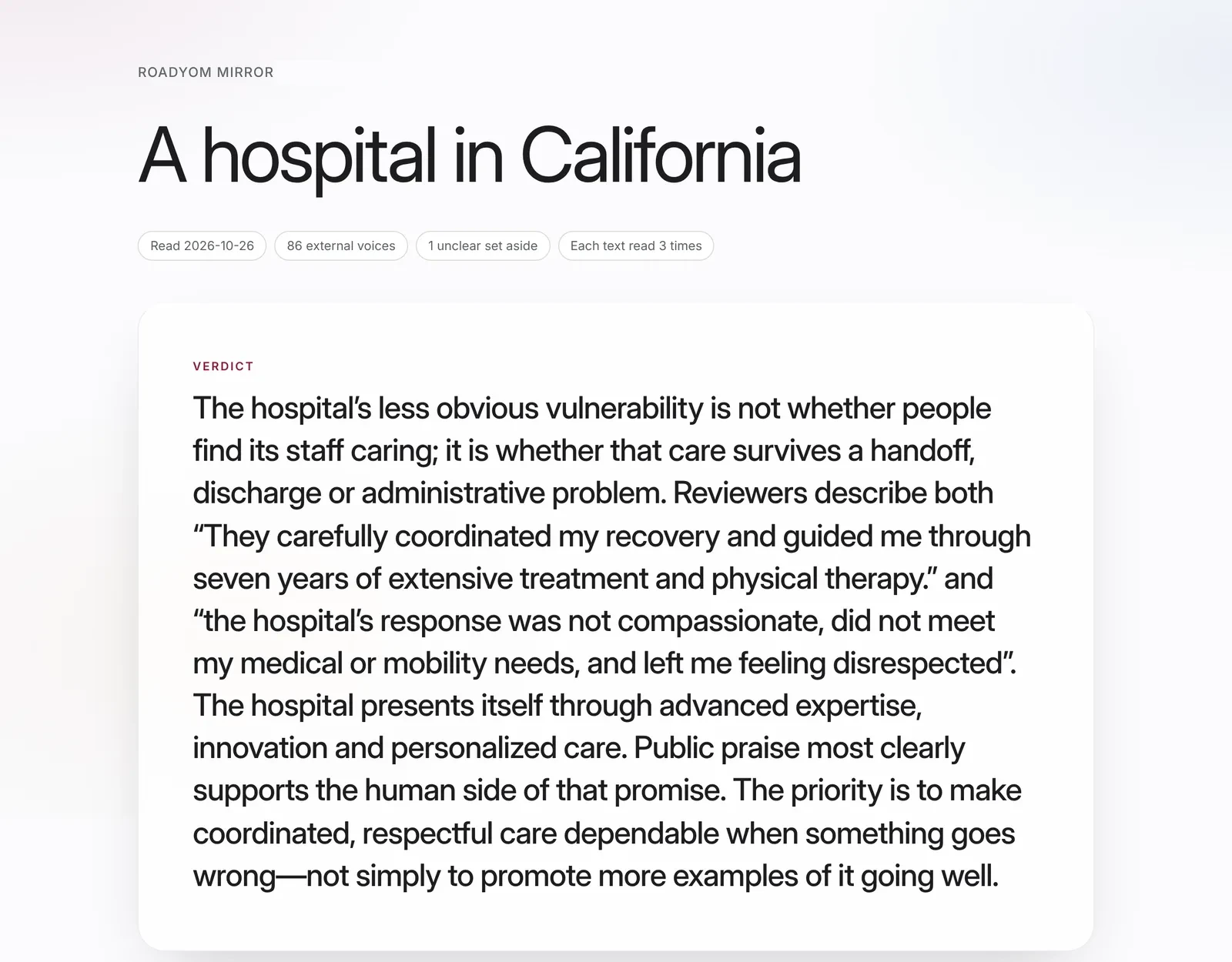
The verdict of a real Mirror reading, with its sources

From a real Mirror reading of a hospital in California, built from public sources. Names withheld.

ROADYOM REFRACTION PeoplePreview

Cover before leave.

People records, rosters and time off for a network of branches. Approving a request re-checks the branch’s cover for those days. Certificates carry their dates.

  • Nobody approves their own request.
Explore Refraction
Refraction: the people record of a whole institution, with what needs a decision todayRefraction: the people record of a whole institution, with what needs a decision today
Your first 30 days

Start small. Start this week.

Two branches, one month. A busy one and a calm one, so you see the difference.

  1. Week 1

    Choose two branches.

    Name a coordinator in each, often the branch’s service lead. Mirror reads the bank’s public image as an outside baseline.

  2. Week 2

    Adapt the guide.

    Add your own situations: explaining a document rule, a fee, a transfer delay. Staff join by QR. The branch manager approves.

  3. Week 3

    Round at the peaks.

    Opening hour, salary days, the afternoon rush. Coordinators record what worked, by name.

  4. Week 4

    Share the answer that worked.

    Review the journey against the targets you set. Put the answers that worked into Prism, so every branch gives them.

Honest scope

What Roadyom won’t do.

Knowing the limits is part of trusting the tool.

No customer data.

No names, no account numbers. Reflection refuses free text that holds a long number or an email.

Not a queue system.

It doesn’t issue tickets or time waits. A round records what a person saw.

Not a compliance tool.

It doesn’t do KYC, audits or regulatory reporting.

No teller rankings.

No screen or keystroke tracking. Nobody is ranked against a colleague.

How we handle data, product by product

Questions, answered.

Does it connect to our queue system?

No. Reflection records what coordinators observe on the floor. “Anyone waiting longer than expected?” is a person’s judgement, not a timer.

Can we compare branches?

Each branch sees its journey against its own targets. Team figures appear only for groups of five or more.

Will our regulator object?

Roadyom holds no customer or account data. It holds what your staff chose to record about service practice.

Does Mirror read our complaints inbox?

No. Public sources only: reviews, videos and news. No data behind a login.

What does it cost?

Reflection starts at $8 per user per month, Prism at $16 per active user, each with a 14-day trial. Mirror starts with a free preview.

Start with two branches.

A live 30-minute demo, built around your branches.