ROADYOM
EN
Get started
For NGOs and humanitarian teams

Dignity is delivered by people.

A registration table, a distribution line, a home visit. The people you serve judge your organization by how they were received, and remember it after the project ends.

Works offline in the field No beneficiary data Lessons kept across rotations

A field team plans together around a whiteboard
Where the image is made

Projects end. What your people learn shouldn’t.

In humanitarian work, the organization is the person at the table. Their patience, their explanation, their “no” said with respect. That is your reputation in the community. It deserves the same care as the supplies.

  1. The registration table

    How the “no” is said.

    Long lists, missing papers, people who travelled far. The answer may be no. How it is said decides whether they come back.

  2. The distribution line

    Who goes first, and why.

    Say older people go first, then families with infants. Explained, the order feels fair. Unexplained, it feels like favour.

  3. The feedback line

    The complaint that goes nowhere.

    A number on a poster. If nothing comes back, people stop calling, and the warning signs go quiet.

  4. Rotation day

    The hand-over that never happens.

    A field coordinator leaves after six months. The relationships and the lessons leave too, unless someone wrote them down.

Field notes and photographs spread on a desk under a lamp

Every rotation is a test of memory.

Pass it on paper, and the next team starts where you stopped.
What the research says

Evidence first. Then the product.

We read the research before we build. Here is what it says about this work, and what it means in practice.

Humanitarian Practice Network 55

Turnover breaks hand-overs and memory.

Network Paper 55 found that high turnover and frequent rotation make proper hand-overs less likely and institutional memory hard to preserve. Investing in relationships also becomes less appealing when a stay will be short.

Prism keeps lessons, decisions and procedures with their sources, so the hand-over doesn’t depend on one conversation.

Loquercio D., Hammersley M., Emmens B., “Understanding and addressing staff turnover in humanitarian agencies”, HPN Network Paper 55, ODI, 2006
Core Humanitarian Standard Lowest

Complaints are the weakest commitment.

CHS Alliance reports that Commitment 5, on complaints being welcomed and addressed consistently, has scored lowest of all commitments in verification since the standard was created.

Reflection’s Front-line service guide includes “resolving a problem or complaint” as a practised situation, not a poster.

CHS Alliance, “Building trust through quality complaint systems”

We cite research to explain our method. It is not a promise of results in your institution.

Where each product fits

The belief, made practical.

Memory first, for teams that rotate. Then practice at the table, even without a signal.

ROADYOM PRISM Memory

Lessons that survive rotation.

What worked at the last distribution, why a site was chosen, how a referral is made. Each item shows how far it can be trusted. A steward ratifies. When two items disagree, Prism opens a dispute instead of overwriting.

  • Observations from the field stay marked as observations.
  • After a plan ends, the memory stays, read-only.
Explore Prism

Every item in Prism carries one of four levels.

  1. 1 Ratified A steward confirmed it. Search ranks it first.
  2. 2 Evidenced It points to a source you can open.
  3. 3 Observed Someone saw it in the field.
  4. 4 AI-inferred An assistant wrote it. It stays here until a person ratifies it.

ROADYOM REFLECTION Inside

Practice at the table, offline.

Start from the Front-line service guide: welcome, explaining a procedure or a wait, de-escalating tension, resolving a complaint, handing over. Records are saved on the phone first and sent when the network returns.

  • Volunteers and staff join by QR. A manager approves each one.
  • Each person sees only their own path. No one is ranked.
Explore Reflection
A field team around a whiteboard

ROADYOM STAR Events

Charity markets, run properly.

For organizations that host bazaars and fairs: exhibitor applications, booths on a floor map, fees, event-day check-in and each exhibitor’s history. The organizer decides.

  • No automatic accept or reject.
Explore Star
Star on a desktop: the floor map of a three-day market, booths taken and free

ROADYOM MIRROR Outside

What is said about you in public.

Mirror reads public news, videos and reviews about your organization, and sets them beside what you say about yourselves. For many NGOs public evidence is thin, and the reading will say so.

  • It reads institutions, never individuals.
Explore Mirror
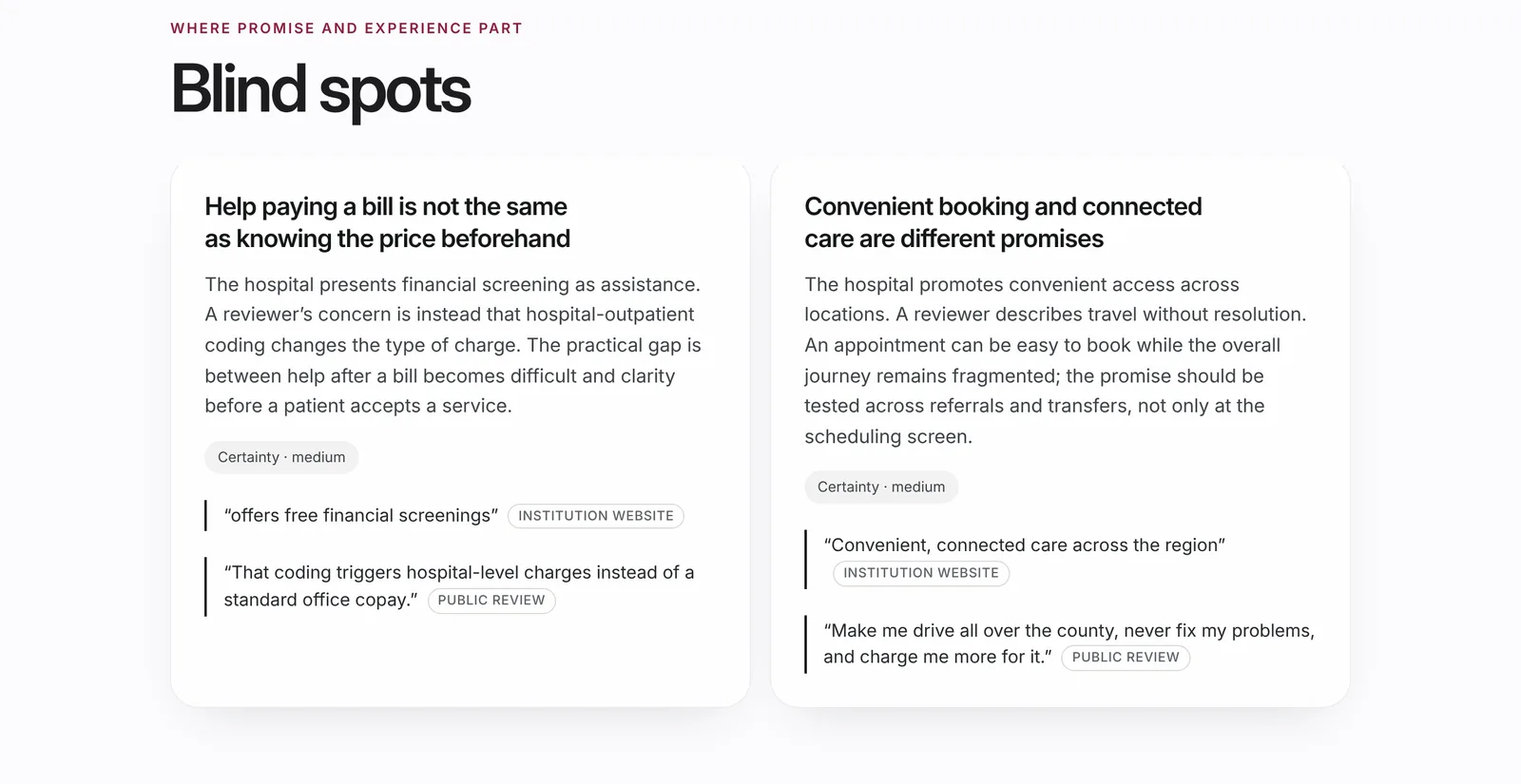
Blind spots in a real Mirror reading, each with its quotes and certainty

From a real Mirror reading of a hospital in California, built from public sources. Names withheld.

Your first 30 days

Start small. Start this week.

One site, one team, before the next rotation.

  1. Week 1

    Capture what you know.

    Put the last project’s lessons and decisions into Prism. A steward ratifies what holds.

  2. Week 2

    Adapt the guide.

    Registering, explaining who goes first and why, handling a complaint, referring on. Volunteers join by QR.

  3. Week 3

    Document on site.

    Coordinators record good practice by name, offline if needed. Colleagues review the guide two minutes a day.

  4. Week 4

    Hand over in writing.

    Review the journey with the team. Record this month’s decisions with their reasons before anyone rotates.

Honest scope

What Roadyom won’t do.

Knowing the limits is part of trusting the tool.

No beneficiary data.

Reflection records the situation, never the person served. It refuses phone or file numbers in free text.

Not case management.

It doesn’t register beneficiaries, track cases or distribute aid.

Not your feedback mechanism.

It helps staff handle complaints well. It doesn’t replace the channel people use to reach you.

Not proof of impact.

The journey shows interventions as a sequence of events, never as proof of cause. No religion, sect or political inference.

How we handle data, product by product

Questions, answered.

Does it work without connectivity?

Reflection saves on the phone first and sends when the network returns. It installs from the browser on iPhone or Android.

Do you store beneficiaries’ names?

No. Reflection records what a staff member did, in which situation. Never who was served.

Can we use it for donor reporting?

It isn’t built for that. The journey shows indicators against the targets you set, and never claims cause. Use it as evidence of practice, honestly labelled.

Volunteers come and go. Is that a problem?

No. They join by scanning the team’s QR card, and a manager approves. What they learned stays in Prism after they leave.

What does it cost a small NGO?

Reflection starts at $8 per user per month and Prism at $16 per active user, each with a 14-day trial.

Before the next rotation.

A live 30-minute demo, built around your field teams.