ROADYOM
EN
Get started
For hospitals

Patients remember people.

Before the diagnosis, there is the door, the desk and the wait. That is where a hospital’s image is made, by the people who work there, shift after shift.

Guides for emergency, admission, security and information No patient data People decide

A coordinator with her phone in a full hospital waiting area
Where the image is made

The image is made between two patients.

A hospital can spend years on its reputation. A family decides in ten minutes at the emergency door. The people at that door are the hospital’s image. So that is where we start.

  1. Emergency entrance

    The first face at the door.

    Someone arrives frightened, often with family behind them. Before any triage, they read the face that meets them, and whether anyone looked up.

  2. Waiting room

    The wait no one explains.

    Priority goes to the most serious case, not the first to arrive. Said plainly, that is fair. Left unsaid, it feels like being forgotten.

  3. Admission office

    Papers, costs and the next step.

    Which documents? What is covered? Where to go next? A vague answer sends the family back and forth, and the stress lands on the patient.

  4. Between units

    The hand-over no one owns.

    A patient moves from emergency to a ward, or from one site to another. If nobody owns that moment, the family feels it first.

Colleagues walk together down a bright hospital corridor

Every shift writes the hospital’s reputation.

Not the brochure. Not the billboard. The next twelve hours.
What the research says

Evidence first. Then the product.

We read the research before we build. Here is what it says about this work, and what it means in practice.

BMJ · 12 countries 12

Patients feel the conditions nurses work in.

Surveys of nurses and patients in hospitals across Europe and the United States found that better nurse work environments and fewer patients per nurse went with higher patient satisfaction and better-rated care.

What patients report is built inside, by how staff are supported. That is why Reflection works with the team, not around it.

Aiken L.H. et al., “Patient safety, satisfaction, and quality of hospital care”, BMJ 2012;344:e1717
The psychology of waiting 8 rules

Unexplained waits feel longer.

David Maister’s classic propositions: uncertain waits feel longer than known ones, unexplained waits longer than explained ones, and unfair waits longer than equitable ones.

Reflection’s emergency waiting-room round asks every hour: is their next step clear to them? Is anyone feeling left alone?

Maister D.H., “The Psychology of Waiting Lines”

We cite research to explain our method. It is not a promise of results in your institution.

Where each product fits

The belief, made practical.

Four products work in hospitals today. Each one keeps the evidence. None decides about a person.

ROADYOM REFLECTION Inside

Rounds that keep practice alive.

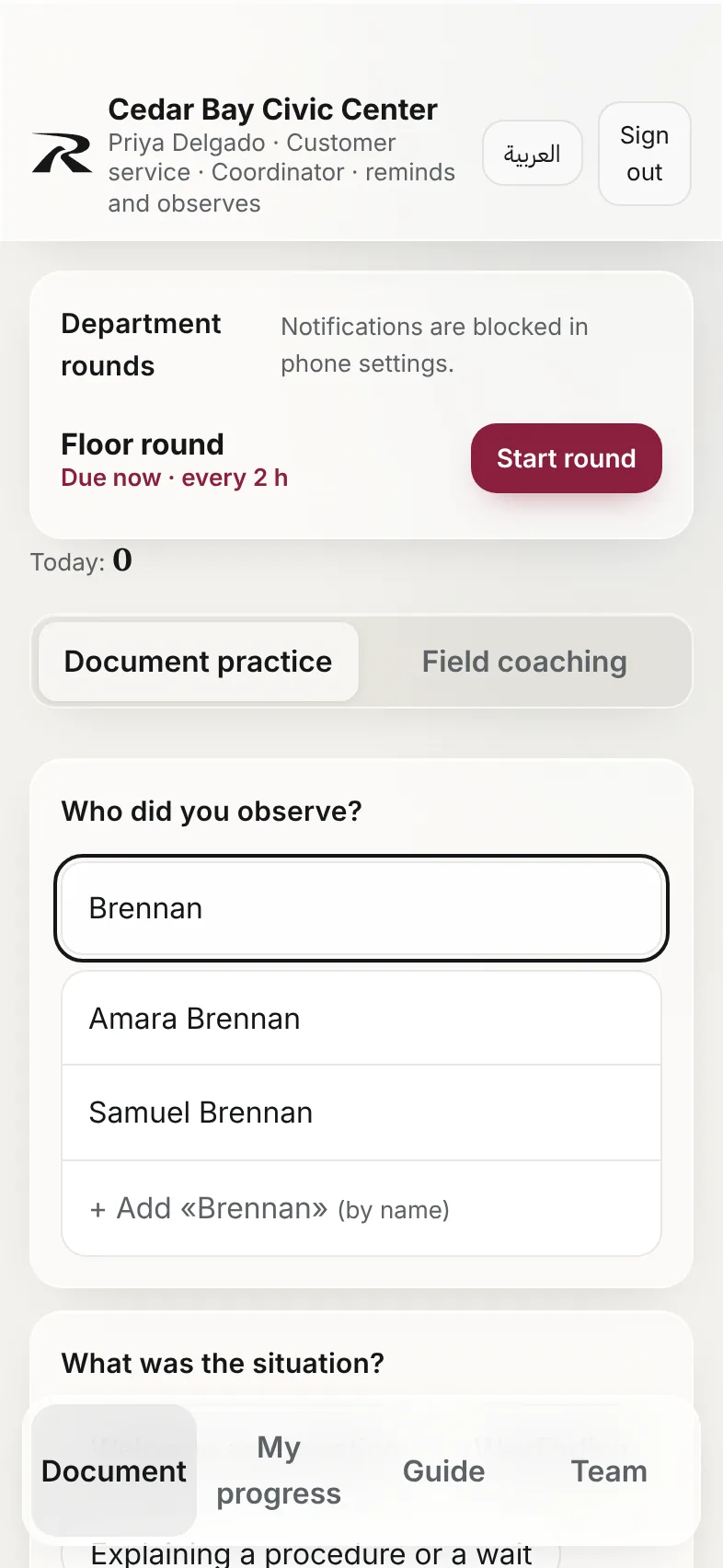
Ready guides for the departments where patients form their first impression. The phone reminds the coordinator when a round is due. She records what a colleague did, in three taps, before the moment passes.

  • Emergency: a waiting-room round every hour.
  • Admission office, security and information desk: their own situations and rounds.
  • Your own round form can become the department’s guide.
Explore Reflection
A staff member at a reception desk checks the app on her phone
Reflection: the waiting-room round is due, and the colleague the coordinator just observed

ROADYOM MIRROR Outside

What patients say in public.

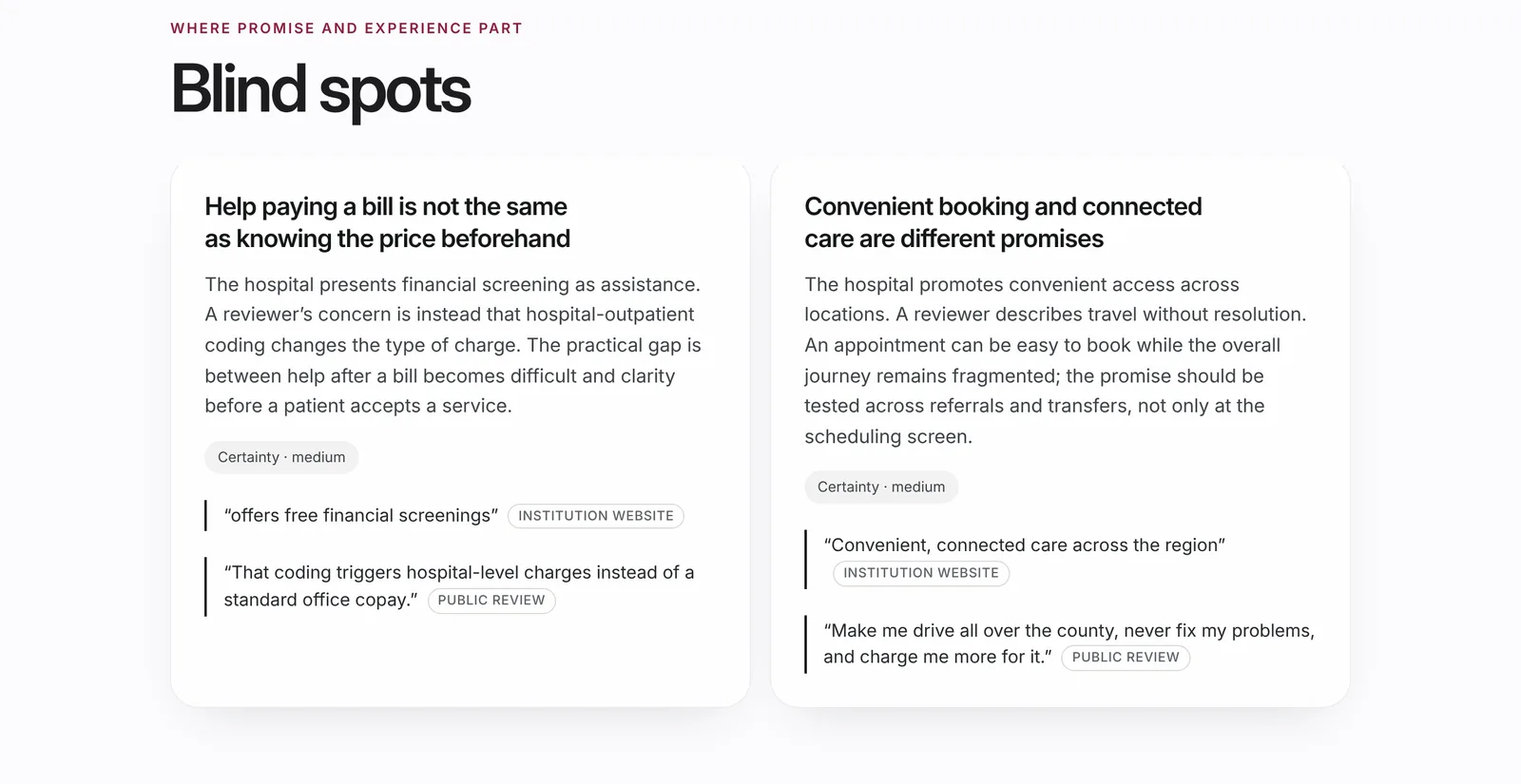
Mirror reads what the hospital promises and what people live, in public reviews, videos and news. In one real reading, the hospital replied to 18.6% of its public reviews. A comparable hospital replied to 86.7%.

  • Blind spots, each with its quotes.
  • Ranked actions with impact and effort.
  • Comparable hospitals, read the same way.
Explore Mirror
Blind spots in a real Mirror reading, each with its quotes and certainty

From a real Mirror reading of a hospital in California, built from public sources. Names withheld.

ROADYOM REFRACTION PeoplePreview

Every licence, with its date.

Licences, clinical privileges and re-credentialing in one place. A roster that refuses a day shift right after a night. Time off approved with the department’s cover in view.

  • Expired certificates flagged before anyone is scheduled.
  • A person decides. The record remembers who, what and when.
Explore Refraction
Refraction: licences, clinical privileges and committee approvals

ROADYOM PRISM Memory

Why the rule exists.

The decisions behind a visiting policy, a triage script, a discharge step. With their reasons, and with how far each can be trusted. So the next head nurse inherits the why, not only the rule.

  • Lessons from rounds, kept beside their evidence.
  • Nothing becomes trusted until a named person ratifies it.
Explore Prism

Every item in Prism carries one of four levels.

  1. 1 Ratified A steward confirmed it. Search ranks it first.
  2. 2 Evidenced It points to a source you can open.
  3. 3 Observed Someone saw it in the field.
  4. 4 AI-inferred An assistant wrote it. It stays here until a person ratifies it.
Your first 30 days

Start small. Start this week.

A first month with two departments. Small enough to start this week. Real enough to show you something.

  1. Week 1

    Choose two doors.

    Usually emergency and admission. Name a coordinator in each. Mirror reads your public image, so you have an outside baseline.

  2. Week 2

    Agree the guide.

    Start from the ready guide, or bring your own round form. Staff scan the department’s QR card. A manager approves each request.

  3. Week 3

    Walk the rounds.

    The phone reminds coordinators when a round is due. They document good practice by name. Colleagues review five guide cards a day.

  4. Week 4

    Look, then decide.

    Management opens the journey: each indicator against the targets you set. What to change next is your call.

Honest scope

What Roadyom won’t do.

Knowing the limits is part of trusting the tool.

No patient records.

Reflection records the situation, never the patient. It refuses free text that holds an email or a long number, like a file number.

No clinical decisions.

It doesn’t triage, diagnose or replace your clinical systems.

No ranking of staff.

Each person sees their own path. Team figures appear only for five or more. No location or screen tracking.

Not a patient survey.

Mirror reads a public sample and states its size. It doesn’t speak for all your patients.

How we handle data, product by product

Questions, answered.

Does Reflection replace our patient experience survey?

No. A survey asks patients afterwards. Reflection works during the shift: coordinators observe, record and remind, and the journey shows how practice moved against your targets.

Which departments should we start with?

Where patients form their first impression: emergency, admission, the information desk and security. Ready guides exist for all four.

Can we use our own round form?

Yes. The emergency guide itself was drawn from a hospital’s own round form. Bring yours. Once approved, it becomes the department’s guide.

Will nurses feel watched?

Reflection records good practice by name and coaching on the spot. Nobody is ranked against a colleague, and nothing is tracked in the background.

What if the network drops in the basement?

Reflection saves on the phone first and sends when the network returns.

What does it cost?

Reflection starts at $8 per user per month, with a 14-day trial. Mirror starts with a free preview.

Start at the emergency door.

A live 30-minute demo, built around your departments.